
Requirement registry
Delivery work is expected to connect behavior, docs, tests and release evidence so “done” is auditable.
requirements:check
The Jumentix mark comes from the Brazilian jegue: steady, practical, resilient. The platform carries enterprise Node.js architecture from the first modular monolith to an unlimited service landscape.
The animal is the promise: less ceremony, more load-bearing software.
Jumentix carries the load
The jegue is part of the product language: dependable movement, strong footing, and no drama when the terrain changes. Jumentix applies that to visual domain design, contract-first runtimes, reusable adapters, developer automation, and deployment governance.
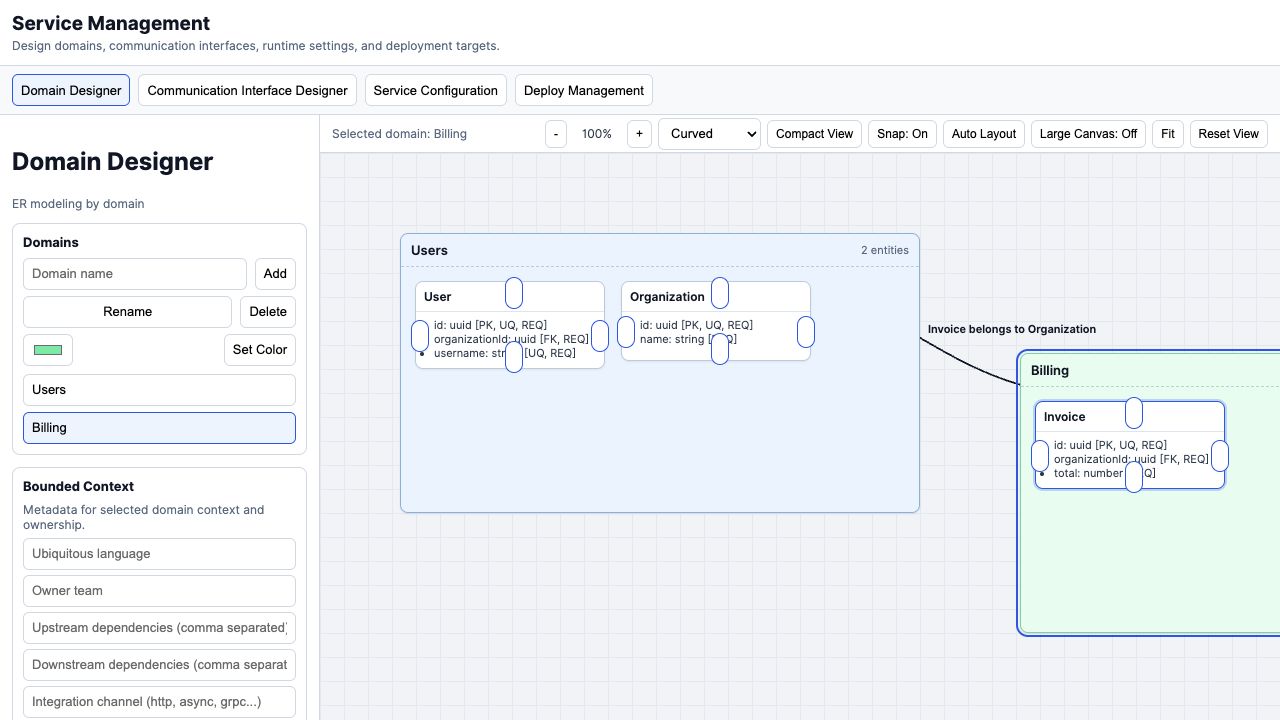
The Domain Designer turns domains, entities, fields, validation, and relationships into a navigable model. The same contracts guide code generation and API documentation.
Code is part of the product
The same application contracts work across a modular monolith, realtime server, functions, and distributed services.
bun install
bun run cli
bun run dev:express
Bun-powered tooling
Jumentix standardizes on Bun as the pinned monorepo runtime, package manager, script runner, test runner and browser-spec bundler. That keeps local work, CI gates, package checks and website publishing on one toolchain.
The repository uses Bun where it actually reduces friction: fast installs with workspaces, direct TypeScript execution, repeatable package scripts, focused branch gates, and browser-test bundling before Cypress runs against real IndexedDB and DOM APIs.
bun install
bun run website:dev
bun run ci:affectedQuality as product surface
Jumentix treats quality as part of the user-facing promise. Requirements are checked, tests are mapped, architecture rules are executable, and publish paths carry evidence instead of relying on ceremony.
Delivery work is expected to connect behavior, docs, tests and release evidence so “done” is auditable.
requirements:checkUnit, integration, Cypress route sweeps, browser specs and Storybook smoke checks cover the surface each layer actually owns.
test-map:checkBoundary scripts reject imports and shortcuts that would leak frameworks, databases or infrastructure into domain code.
arch:check-*Content sync, route checks, package dry-runs and release governance run before public artifacts move.
website:test:prepublishbun run requirements:check
bun run docs:consumers:package-scripts
bun run website:test:prepublishAI-ready platform
Jumentix is prepared for AI because the product does not ask agents to infer architecture from scattered code. The UI captures bounded contexts, entities, interfaces, deployment profiles and requirements; the repository exposes agent-readable docs and executable checks that keep generated work accountable.
Category, Task, relationships, validations and API surfaces become explicit platform data.
The agent reads the docs index, package contracts and UI blueprint before choosing files to change.
Use-cases, controllers, SDK clients, Cana examples and runtime profiles keep their ownership boundaries.
Requirements, test maps, architecture scripts, route checks and prepublish gates validate the change.
Reviewers see what changed, why it fits the architecture and which checks prove it is ready.
Agents can start from docs index, package pages, route metadata and code snippets instead of guessing which file owns a behavior.
/llms-full.txtThe Service Management UI turns product concepts into bounded contexts, interfaces and deployment choices that generators and reviewers can inspect.
service-management-uiGenerated or agent-authored changes still pass requirements, test maps, route checks, package boundaries and release governance before publication.
requirements:checkReusable packages give AI work stable names for persistence, mediation, clients, Cana, runtime bootstrap and architecture boundaries.
packages/*The UI gives AI a constrained starting point: the service vocabulary, boundaries, interfaces, runtime profile and quality obligations are explicit before a prompt is written. That turns the agent from a code guesser into a contributor working inside the platform rules.
| AI action | UI source | Governance guardrail | Useful output |
|---|---|---|---|
| Design safely | Bounded context, entities, relationships and requirements. | Service model validation and requirement registry. | A service spec that product, architecture and engineering can review together. |
| Generate safely | Interfaces, events, deployment profile and package choices. | OpenAPI, AsyncAPI, route checks and workspace boundaries. | Contracts, SDKs, handlers and examples aligned to the same model. |
| Ship with evidence | Quality expectations, release path and docs index. | Test map, architecture checks, docs sync and prepublish gates. | A PR reviewers can audit with concrete proof instead of narrative confidence. |
{
  "boundedContext": "Tasks",
  "entities": [
    { "name": "Category", "fields": ["id", "name", "color"] },
    { "name": "Task", "fields": ["id", "title", "categoryId", "completed"] }
  ],
  "interfaces": ["REST", "WebSocket"],
  "deploymentProfiles": ["dev", "staging", "production"],
  "requirements": ["REQ-TASK-CATEGORY", "REQ-TASK-LIVE-UPDATES"],
  "governanceChecks": [
    "requirements:check",
    "test-map:check",
    "arch:check-workspace-boundaries"
  ]
}
Choose a delivery path
Ship OpenAPI 3.1 services with interchangeable native HTTP adapters.
Explore the blueprintRun Socket.IO or gRPC beside a REST fallback and AsyncAPI documentation.
Explore the blueprintLaunch one deployable with domain boundaries ready to become services.
Explore the blueprintKeep service communication contract-based with the Message Mediator.
Explore the blueprintBuild frontend products that share generated SDKs and work offline.
Explore the blueprintJumentix is for teams that want framework speed without surrendering domain ownership, portability, or operational evidence.
Explore the source, run the factory locally, and turn your next Node.js service into a repeatable platform capability.